Enterprise Capabilities Models (ECMs) as a Knowledge Management Tools
Enterprise Capability Models (ECMs) are often used for enterprise architecture models for the purposes of binding or relating different constructs together. However, for those who understand ECMs, there value can be much greater to an organization.
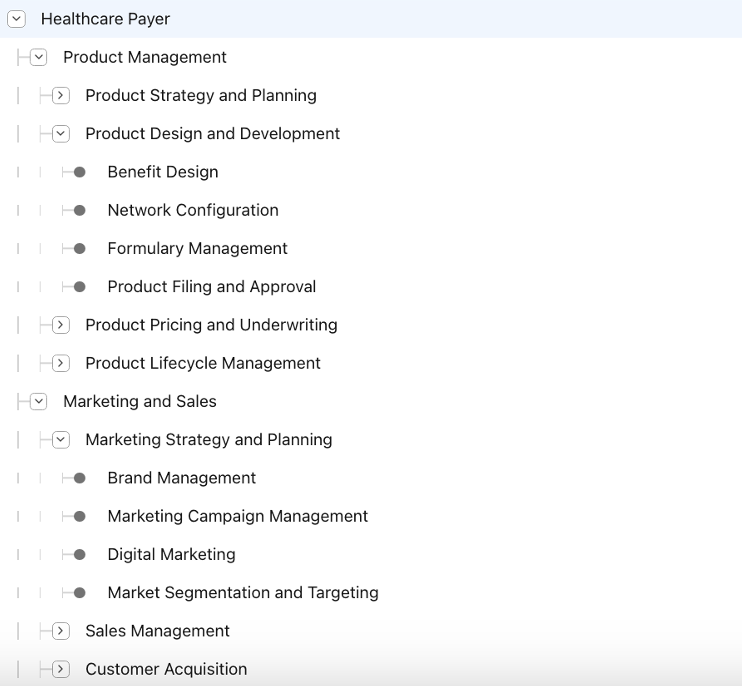
What is an Enterprise Capability Model (ECM)?
An Enterprise Capability Model (ECM) is a tool that is created as an output of the practice of Business Architecture. Business Architects and Enterprise Architects create this tool, most often in the form of a multi-level indented taxonomy. However, other forms such as highly normalized tables are also common. The ECM, once created, is commonly used to correlate different Enterprise Model (EM) constructs to business and IT capability and functional areas. For example, your CRM system that might be called “Alpha” has a name that has no contextual meaning. By correlating it to Marketing and Sales capabilities and functions in your model, you are giving it functional context that is not clear in the application’s name. When you’ve correlated all applications to their capabilities and functions, you have a better understanding of their purpose, and now you can ask and more easily answer questions about your EM, such as “What are all the applications used by Marketing?” When you correlate even more enterprise data, such as Application Incidents, you can start to ask even deeper questions like: “If I modify application X, what functional business areas are impacted?”
To many smaller enterprises, this might sound ridiculous but consider that when you get into larger enterprises that have hundreds or even thousands of applications spread across different division and business areas, answering such questions is not as easy as one would think.
For those in larger enterprise who suffer such pains, an ECM can be a very powerful tool… if used correctly.
Enterprise Capability Models (ECMs) as Knowledge Management (KM) constructs
The fact that an ECM can be modeled as a taxonomy instantly puts it into the area of Knowledge Management (KM), where knowledge taxonomies are critical tools for organizing, classifying, relating, and sharing data and information as knowledge. In fact, such taxonomies are the baseline for more complex ontologies that further facilitate knowledge discovery, consumption, and utilization in enterprises.
So, how can an ECM help with KM? The answer is simple. An ECM becomes the backbone structure for organizing, classifying, relating, and sharing enterprise-related data and information.
Just think of the things that can be related to each other, either directly or indirectly through a mature and fully described ECM…
-
Capabilities/Functions,
-
Applications/Systems,
-
Data and Information,
-
Integrations,
-
Data Stores (databases, file systems, etc.)
-
Value Chains,
-
Strategies,
-
Regulations,
-
Standards,
-
Policies,
-
Facilities,
-
Data Centers,
-
Market Sectors,
-
Market Segments,
-
Organizations,
-
Stakeholders,
-
Roles and Responsibilities,
-
Partners,
-
Offerings (Products & Services),
-
Sales/Distribution Channels,
-
Customers,
-
…and so much more!
When each of the above items are fully described, including the Capabilities and Functions in the ECM, your enterprise will have a fully described enterprise with detailed linkages from any one node in your model to all its related nodes.
A mature model like this can offer answers for direct correlations (e.g., Applications directly related to specific Capabilities & Functions) or indirect correlations (e.g., Data tied to Applications, which are tied to Capabilities, which are tied to Organizations can tell you what data a specific organization relies on).
ECMs can be enterprise-generic or industry-specific
The power in these models is that you can tailor them to be very enterprise-generic, meaning they become common knowledge solutions that apply across different industries, or you can evolve them to be very industry-specific, meaning you can cross from generic into industry-specific knowledge solutions. The choice of how much knowledge you wish to pursue and correlate into your model is up to you and your enterprise.
Sharing your ECM and EM for better Enterprise KM (EKM)
One thing so many Enterprise Architecture organizations often fail at is the broader sharing of their well-formed EMC and EM models with the broader enterprises they serve. They build such constructs in very expensive tools (e.g., Enterprise Architecture Modeling Tools) that have limited sharing abilities, usually because of both technical and cost limitations.
How to share such enterprise data and information can be solved in multiple different ways. One very powerful solution is to use a data compiler that automatically generates a static wiki representation for all of the model’s data and information as constructed Nodes and Relationships with appended data. Each record is a wiki page and each relationship between records is a link to another record wiki page. Such data compilers rapidly scour the model and create static HTML pages with embedded links. The end result can often be hundreds-of-thousands and often millions of static web pages consisting of useful content that can form the backbone of a very powerful enterprise intranet.
Another advantage of such data compilers is that they can adapt to change very easily and quickly. If data in the model changes, just recompile, and a whole new wiki will get created and published.
This published EM structure helps the broader employee base better see enterprise data the way architects do. It helps them find data information, consume it, and ramp up quicker and more easily than they normally would. It helps them answer questions and solve real problems quicker and more easily than they normally would. Such speed in getting to problem solving means the cost for employees to find the answers they need and create the solutions they need translates to cost savings in the broader enterprise Ways-of-Working (WoW), which is a critical concern for Enterprise Knowledge Management (EKM).
Conclusion
Look to build and leverage thoroughly described Enterprise Capability Models (ECMS) as the backbone of your Enterprise Knowledge Management (EKM) efforts. Done correctly, the broader sharing of Enterprise Model data and information will enable your organization’s workers to get things done faster, with less error, and for less money.